


Tetraponera rufonigra
- Taxonomy: Subfamily Formicinae, Tribe Tetraponera
- Distribution: South Asia
- Color: red with black abdomen/head
- Size:
- Nutrition: Honey- or sugar water and insects, also sometimes captures small ants
- Hibernation: No
- Climate: tropical (dry)
- Nest building: Nests in dry death wood
- Planting: nothing specific
- Level: easy
- Specifics: Has a very good sight
 Tetraponera rufonigra was added to the shopping cart.
 Tetraponera rufonigra could not be added to the shopping cart.
| Colony
- Currently not available With about 100 workers |


Proatta butteli
Proatta looks like a miniature Atta but isn't related to it. This species don't breed fungi and don't cut leaves. There don't exists cast building. It is easy to keep.
- Taxonomy: Subfamily Myrmicine, Tribe Stenammini
- Distribution: South-East Asia
- Color: Worker: golden, Queen: brownish yellow
- Nutrition: dead insects and honey-/sugar water
- Nest building: Soilnest
- Climate: Tropical rainforest
- Specifics: Queen feign death if in danger, workers are otherwise very fortified
Proatta butteli was added to the shopping cart. Proatta butteli could not be added to the shopping cart.| Colony with 60-100 workers, two Queens - Currently not available |


Polyrhachis sp. 8 "Erdbewohner"
- Taxonomy: Unterfamilie Formicinae, Tribus Camponotini
- Herkunft: Asien
- Winterruhe: Nein
- Aussehen:silbrig-schwarz
- Nestbau: Erdnester
- Nahrung: Honigwasser, Insekten
- Temperatur: 25 - 28 °C
- Luftfeuchtigkeit: 60 - 80 % (tropisches Klima)
- Bodenbeschaffenheit: Nur für etwaige Bepflanzung notwendig
- Haltungsklasse: einfach
Polyrhachis sp. 8 "Erdbewohner" was added to the shopping cart. Polyrhachis sp. 8 "Erdbewohner" could not be added to the shopping cart.| Colony
- Currently not available with 50-70 workers |

Polyrhachis sp. 7
This is a beautiful black colored tropical Polyrhachis species of Southeast Asia. It is an undemanding, diurnal, and tame species.
- Taxonomy: Subfamily Formicinae, Tribe Camponotini
- Distribution: Southeast Asia
- Hibernation: No
- Appearence: shiny black
- Colony size: small
- Nest bulding: weaved nests between green leafes
- Nutrition: honeywater, insects and other small animals
- Temperature: 25 - 28°C
- Air humidity: 60 - 80 % (tropical rainforest)
- Soil conditions: only necessary for planting
- Planting: usefull because they like walking on plants
Polyrhachis sp. 7 was added to the shopping cart. Polyrhachis sp. 7 could not be added to the shopping cart.| Colony
- Currently not available With 10-20 workers |


Polyrhachis sp. 5
This is a small red colored indonesian Polyrhachis species that creates it's weave nests between leafes. Colonies are not very populous and are ideal for keeping in community basins.
- Taxonomy: Subfamily Formicinae, Tribe Camponotini
- Origin: Indonesia
- Hibernation: No
- Appearence: red
- Nest bulding: Cocon nests primarily between leafes
- Nutrition: honeywater, insects
- Temperature: 25 - 28°C
- Air humidity: 60 - 80 % (tropical rainforest)
- Soil conditions: only necessary for planting
- Planting: i.e. Ficus, Pachira aquatica
- Level: Medium
Polyrhachis sp. 5 was added to the shopping cart. Polyrhachis sp. 5 could not be added to the shopping cart.| Small colonie
- Currently not available With about 8 workers Shipping restrictions: Shipping only within Germany | |
| Large Colony
- Currently not available with 100-150 workers |


Polyrhachis sp. 4
This is a small shinny black colored indonesian Polyrhachis species that creates it's weave nests between leafes. Colonies are not very populous and are ideal for keeping in community basins.
- Taxonomy: Subfamily Formicinae, Tribe Camponotini
- Origin: Indonesia
- Hibernation: No
- Appearence: shinny black
- Nest bulding: Cocon nests primarily between leafes
- Nutrition: honeywater, insects
- Temperature: 25 - 28°C
- Air humidity: 60 - 80 % (tropical rainforest)
- Soil conditions: only necessary for planting
- Planting: i.e. Ficus, Pachira aquatica
- Level: Medium
Polyrhachis sp. 4 was added to the shopping cart. Polyrhachis sp. 4 could not be added to the shopping cart.| Small Colony
- Currently not available With 15-20 workers | |
| colony
- Currently not available With 150-200 workers |

Polyrhachis sp. 3
This is a small black colored peaceful indonesian Polyrhachis species that creates it's weave nests between leafes. Colonies are not very populous and are ideal for keeping in community basins. This species have large thorns and slight red leegs.
- Taxonomy: Subfamily Formicinae, Tribe Camponotini
- Origin: Indonesia
- Hibernation: No
- Appearence: black with large thorns
- Nest bulding: Cocon nests primarily between leafes
- Nutrition: honeywater, insects
- Temperature: 25 - 28°C
- Air humidity: 60 - 80 % (tropical rainforest)
- Soil conditions: only necessary for planting
- Planting: i.e. Ficus, Pachira aquatica
- Level: Medium
Polyrhachis sp. 3 was added to the shopping cart. Polyrhachis sp. 3 could not be added to the shopping cart.| Colony
- Currently not available With approx. 60 70 workers Shipping restrictions: Shipping only within Germany |


Polyrhachis sp. 2
This is a black aggressive indonesian polyrhachis species that builds weaved nests under leafes. It is a monogyn rarer species compared to other Polyrhachis. A remarkable characteristic is the hammertone finish like black head and thorax. This strong about 1 cm large Polyrhachis builds smaller colonies compared to other Polyrhachis.
- Taxonomy: Subfamily Formicinae, Tribe Camponotini
- Origin: Indonesia
- Hibernation: No
- Appearence: black (hammertone finish) with large thorns
- Size: Workers 1 cm
- Nest bulding: Cocon nests primarily between or under leafes
- Nutrition: honeywater, insects
- Temperature: 25 - 28°C
- Air humidity: 60 - 80 % (tropical rainforest)
- Soil conditions: only necessary for planting
- Planting: i.e. Ficus, Pachira aquatica
- Level: Medium
Polyrhachis sp. 2 was added to the shopping cart. Polyrhachis sp. 2 could not be added to the shopping cart.| Colony
- Currently not available With approx. 50 workers |


Polyrhachis sp.
This is a large bluish shinny black Polyrhachis species from Southeast Asia. The colony size is smaller than of the "bulk ants" Polyrhachis dives (max. 150 - 200 ants).
- Taxonomy: Subfamily Formicinae, Tribe Camponotini
- Origin: Southeast Asia
- Hibernation: No
- Appearence: bluish shinny black with large thorns
- Nest bulding: Cocon nests on tree stems and various hollow
- Nutrition: honeywater, insects
- Temperature: 25 - 28°C
- Air humidity: 60 - 80 % (tropical rainforest)
- Soil conditions: only necessary for planting
- Planting: i.e. Ficus, Pachira aquatica
- Level: Medium
Polyrhachis sp. was added to the shopping cart. Polyrhachis sp. could not be added to the shopping cart.| Colony - Currently not available |

Polyrhachis cf. illaudata
In contrast to the Polyrhachis dives these Polyrhachis do not belong to the spining weaver's ants.
They live in natural hollow cavities (e.g., to bamboo canes, wooden trunks or similar).
- Taxonomy: Subfamily Formicinae, Tribus Camponotini
- Origin: Asia
- Winter rest: No
- Color :silbrig black
- Nest construction: Bamboo canes, wooden trunks or similar.
- Food: Honey water, insects
- Temperature: 25 - 28 °C
- Air humidity: 60 - 80% (tropical climate)
- Surface conditions: Only for any(possible) plantation inevitably
- Position class: simply
Polyrhachis cf. illaudata was added to the shopping cart. Polyrhachis cf. illaudata could not be added to the shopping cart.| Colony
- Currently not available with ca. 40-60 workers |


Polyrhachis cf. beccarii
This is a beautiful golden colored tropical Polyrhachis species of Southeast Asia. It is an undemanding, diurnal, and tame species.
- Taxonomy: Subfamily Formicinae, Tribe Camponotini
- Distribution: Southeast Asia
- Hibernation: No
- Appearence: golden
- Colony size: medium
- Nest bulding: dry tree branches or hollow tree trunks
- Nutrition: honeywater, insects and other small animals
- Temperature: 25 - 28°C
- Air humidity: 60 - 80 % (tropical rainforest)
- Soil conditions: only necessary for planting
- Planting: usefull because they like walking on plants
Polyrhachis cf. beccarii was added to the shopping cart. Polyrhachis cf. beccarii could not be added to the shopping cart.| Small Colony
- Currently not available With 2-5 workers | |
| Large Colony
- Currently not available with 100 Workers Shipping restrictions: Shipping only within Germany |

Polyrhachis cf. armata
This is a black aggressive indonesian polyrhachis species that builds weaved nests under leafes. It is a monogyn rarer species compared to other Polyrhachis. A remarkable characteristic is the hammertone finish like black head and thorax. This strong about 1 cm large Polyrhachis builds smaller colonies compared to other Polyrhachis.
- Taxonomy: Subfamily Formicinae, Tribe Camponotini
- Origin: Indonesia
- Hibernation: No
- Appearence: black (hammertone finish) with large thorns
- Size: Workers 1 cm
- Nest bulding: Cocon nests primarily between or under leafes
- Nutrition: honeywater, insects
- Temperature: 25 - 28°C
- Air humidity: 60 - 80 % (tropical rainforest)
- Soil conditions: only necessary for planting
- Planting: i.e. Ficus, Pachira aquatica
- Level: Medium
Polyrhachis cf. armata was added to the shopping cart. Polyrhachis cf. armata could not be added to the shopping cart.| Colony
- Currently not available with 100-150 workers Shipping restrictions: Shipping only within Germany |


Pheidologeton sp. "matt"
This Pheidologeton species is in contrary to Pheidologeton diversus matt black colored and can mostly be found in rain forest. It is a monogyn species. Almost daily they do predatory attacks like the known driver ants in contrary to Pheidologeton diversus where this behaviour is sporadically. The size of this colony is in most cases smaller than of Pheidologeton diversus. It is also not possible to adopt workers or queens like it is possible with Pheidologeton diversus. The workers ride on their queens (for protection) and sometimes also on the soldiers. The difference of size between the workers and soldiers is the biggest of all ant species.
- Taxonomy: Submailiy Myrmicinae, Tribe Pheidologetonini
- Distribution: South-East Asia (Rain forest)
- Color: matt black
- Characteristics: strong polymorph, monogyn
- Nest building: soli nests
- Nutrition: mostly insects and also seeds (nuts)
- Hibernation: No
- Temperature: 25 - 30 °C
- Humidity: 50 - 60% at 28° C (moist ground)
- Soil conditions: loamy sand, loam
- Planting: not necessary
- Accessories: heat source
- Level: for advancer
This is only available once
Pheidologeton sp. "matt" was added to the shopping cart. Pheidologeton sp. "matt" could not be added to the shopping cart.| Colony
- Currently not available with 300-500 workers |


Pheidologeton diversus
- Taxonomy: Submailiy Myrmicinae, Tribe Pheidologetonini
- Origin: Indonesia
- Color: Workers: black, Soldiers: black and also brown
- Characteristics: strong polymorph, monogyn and also polygyn
- Nutrition: insects and seeds
- Hibernation: No
- Temperature: 25 - 30 °C
- Humidity: 50% - 60% at 28° C (moist ground)
- Soil conditions: loamy sand, loam
- Planting: not necessary
- Accessories: heat source
- Level: for advancer
- Specifics: very interesting ants because their predatory attacks like this of driver ants. They also apply fixed "highways" when the colony is great enough. The workers ride on their queens (for protection) and sometimes also on the soldiers. The difference of size between the workers and soldiers is the biggest of all ant species.
Pheidologeton diversus was added to the shopping cart. Pheidologeton diversus could not be added to the shopping cart.| Large colony
- Currently not available With 1 Queens and many thousands workersNo Shipping, only to pick up |


Pheidologeton cf. affinis
New Pheidologeton species from South Asia with browner colored workers.
- Taxonomy: Submailiy Myrmicinae, Tribe Pheidologetonini
- Origin: South Asia
- Color: Workers: brown, Soldiers: black brown
- Characteristics: strong polymorph, monogyn and also polygyn
- Nutrition: insects and seeds
- Hibernation: No
- Temperature: 25 - 30 °C
- Humidity: 50% - 60% at 28° C (moist ground)
- Soil conditions: loamy sand, loam
- Planting: not necessary
- Accessories: heat source
- Level: for advancer
- Specifics: very interesting ants because their predatory attacks like this of driver ants. They also apply fixed "highways" when the colony is great enough. The workers ride on their queens (for protection) and sometimes also on the soldiers. The difference of size between the workers and soldiers is the biggest of all ant species. In contrary to Pheidologeton diversus this species is more active in movement and nest building, and has also slightly smaller workers.
Pheidologeton cf. affinis was added to the shopping cart. Pheidologeton cf. affinis could not be added to the shopping cart.| Colony
- Currently not available Contains about 100 workers |


Pheidole sp. "long legged"
This is a very long-legged Pheidolini, presumable of genus Pheidole. It was found in rotten wood only in deepest intact rain forest.
- Taxonomy: Subfamily Myrmicinae, Tribe Pheidolini
- Distribution: South-East Asia
- Size: Workers: 6 - 7 mm, Soldiers: 8 - 9 mm, Queen: 10 - 11 mm
- Nest building: in rotten wood
- Climate: tropical, moist
Pheidole sp. "long legged" was added to the shopping cart. Pheidole sp. "long legged" could not be added to the shopping cart.

Pheidole cf. noda
This is a very common Pheidole species common in Japan and Southern China.
- Taxonomy: Subfamily Myrmicinae, Tribe Pheidolini
- Distribution: South-East Asia
- Hibernation: no
- Nest building: in soil
- Climate: subtropical
Pheidole cf. noda was added to the shopping cart. Pheidole cf. noda could not be added to the shopping cart.| Colony
- Currently not available With 700 - 1000 workersAvailable once only! |
Pheidole cf. megacephala
- Heimat: Südostasien
- Farbe: Arbeiterinnen: braun, Soldaten: schwarzbraun, teilweise braun
- Eigenschaften: Soldaten
- Nestbau: Erdnester
- Nahrung: Insekten Honig- und ZUckerwasser
- Winterruhe: Nein
- Temperatur: 24 - 28 °C
- Luftfeuchtigkeit: keine besonderen Ansprüche
- Bodenbeschaffenheit: lehmiger Sand oder Lehmerde (z.B. Waldboden)
- Bepflanzung: Nicht notwendig
- Formicarienzubehör: Wärmequelle
- Haltungsklasse: einfach
- Besonderheit: Eine sehr gut zu haltende Pheidole. Auf einen guten Ausbruchsschutz ist zu achten. Die Kolonie kann mehrere Tausend Arbeiteinnen erreichen.
Pheidole cf. megacephala was added to the shopping cart. Pheidole cf. megacephala could not be added to the shopping cart.| Colony
- Currently not available Colony with 4-5 Queens and more than 200-300 workers |
Paratrechina longicornis
- Heimat: Südostasien
- Farbe: Arbeiterinnen: schwarz
- Eigenschaften: schnelles Meldverhalten, gut zu beobachen
- Nestbau: alle möglichen Hohlräume, oft umziehend
- Nahrung: Insekten Honig- und ZUckerwasser
- Winterruhe: Nein
- Temperatur: 24 - 28 °C
- Luftfeuchtigkeit: keine besonderen Ansprüche
- Bodenbeschaffenheit: lehmiger Sand oder Lehmerde (z.B. Waldboden)
- Bepflanzung: Nicht notwendig
- Formicarienzubehör: Wärmequelle
- Haltungsklasse: einfach
- Besonderheit: Eine sehr gut zu haltende Schuppenameise Auf einen guten Ausbruchsschutz ist zu achten. Eine sehr schnelle Ameise, sehr gut zu beobachten. Die Kolonie kann mehrere Tausend Arbeiteinnen erreichen.
Paratrechina longicornis was added to the shopping cart. Paratrechina longicornis could not be added to the shopping cart.| Colony
- Currently not available Colony with two Queens and 100 workers |

Pachycondyla cf tridentata
- Taxonomy: Subfamily Ponerinae, Tribe Ponerini
- Distribution: South Asia
- Color: black
- Size: 20 - 21 mm
- Appearance: black, a little bit red
- Hibernation: No
- Nutrition: Honey-/Sugar water and insects
- Temperature: warm, 24 - 28°C (Rainforest climate)
- Humidity: high
- Soil condition: Humus layer soil
- Nest building: rotten wood (tree roots/branches)
- Planting: Any rain forest plants
- Keeping level: easy
Pachycondyla cf tridentata was added to the shopping cart. Pachycondyla cf tridentata could not be added to the shopping cart.| Colony
- Currently not available with 45-60 workers with Gamergate |


Oecophylla smaragdina
These specie lives in trees like ficus, therein they build their nests. For greater colonies it is better to offer them more trees. They waeve at team work leaves which be use as homebase or louse-cultivation room. Never Nestling in the soil. Use own brood (larvae) to weave
- Origin:Southeast Asia
- Taxonomy: Subfamily Formicinae, Tribe Oecophyllini
- Characteristics: minors and majors
- Hibernation: No
- Appearence of the queen: great, vigorous, often green, brown
- Appearance of the workers: brown, slim with long extremities
- Nest bulding: weaved nests between leaves of trees
- Nutrition: honeywater, insects
- Temperature: 22 - 28°C
- Air humidity: 60 - 80 % (tropical rainforest)
- Soil conditions: only necessary for planting, nesting between leaves
- Planting: ficus
- Level: Medium
Hint: Large Oecophylla smaragdina colonies have many branch nests (polydom) but only one main nest with a mated Queen. Because we don't want to cheat our customers we will only sell opened (verified) nests with guaranteed mated Queens which were usually kept by us several months before we sell. Unopened nests can contain parasites or vermins (Mites, cockroaches, etc.). So called low-cost colonies without Queen are wasted money because you don't take pleasure in very long.
Oecophylla smaragdina was added to the shopping cart. Oecophylla smaragdina could not be added to the shopping cart.| Small Colony
- Currently not available With ca. 50-70 workers Shipping restrictions: Shipping only within Germany | |
| Colony
- Currently not available With 1000-2000 workers Shipping restrictions: No shipping is possible, self collecting is required |

Odontoponera transversa
- Taxonomy: Subfamily Ponerinae, Tribe Ponerini
- Distribution: South-East Asia
- Color: black
- Size: approx. 11 - 14 mm
- Hibernation: No
- Nest building: Soil nests
- Nutrition: Honey-/Sugarwater, insects, likes ripe fruits
- Soil Condition: loam
- Planting: Small tropical plants
Odontoponera transversa was added to the shopping cart. Odontoponera transversa could not be added to the shopping cart.| Colony
- Currently not available With 15- 20 workers |

Odontomachus sp."black"
These ants are able to catapult themselfs up to 40 cm far thru sudden lock up of their mandibles. This mandible lock up is the fastest known mechanism in the fauna. The upper jaw closes with a speed of 38 to 64 m/s. Thru locking up their jaws they are anesthetizing their prey to afterwards sting it to death. It is improper for a corporate tank/formicarium because they will attack any other species at first encounter.
- Taxonomy: Subfamily Ponerinae, Tribe Ponerini
- Distribution: South Asia
- Color: black
- Size: 8 - 12 mm
- Hibernation: No
- Nutrition: Sugar water and insects
- Temperature: 24 - 28 °C
- Nest building: Soil nests and rotten wood
- Keeping level: easy
- Dangers: can sting
Odontomachus sp."black" was added to the shopping cart. Odontomachus sp."black" could not be added to the shopping cart.| Colony
- Currently not available With 30-40 ants |


Odontomachus cf rixosus
These ants are able to catapult themselfs up to 40 cm far thru sudden lock up of their mandibles. This mandible lock up is the fastest known mechanism in the fauna. The upper jaw closes with a speed of 38 to 64 m/s. Thru locking up their jaws they are anesthetizing their prey to afterwards sting it to death. It is improper for a corporate tank/formicarium because they will attack any other species at first encounter.
- Taxonomy: Subfamily Ponerinae, Tribe Ponerini
- Distribution: South-East Asia, Southern America
- Color: brown
- Size: 12 mm
- Hibernation: No
- Nutrition: Sugar water and insects
- Temperature: 24 - 28 °C
- Nest building: Soil nests and rotten wood
- Keeping level: easy
- Dangers: can sting
Odontomachus cf rixosus was added to the shopping cart. Odontomachus cf rixosus could not be added to the shopping cart.| Small colony
- Currently not available With 40-60 workers |


Myrmicaria sp.
An undemanding ants species from the mountains of Southeast Asia which is good for keeping cooler. Because colonies of this species becomes large is is suited for keeping in large basin complxes connected with pipes. Also this Myrmicaria defend oneself with it's defense secretion.
- Origin: Southeast Asia (mountains about 1500 m)
- Taxonomy: Subfamily Myrmicinae, Tribe Myrmicariini
- Characteristics: Monomorph, can not sting
- Hibernation: No
- Appearence of the queen: deep brown with orange thorax, humpy
- Appearance of the workers: deep brown
- Nest bulding: soil nests
- Nutrition: honeywater, insects
- Temperature: 14 - 25°C
- Air humidity: 60 - 80 % (tropical climate)
Note: Shipping abbroad in winter (November-March) at your own risk.
Myrmicaria sp. was added to the shopping cart. Myrmicaria sp. could not be added to the shopping cart.| Colony
- 189.00 € With about 70-100 workers |


Myrmicaria cf arachnoides
These specie build carton nests, similar like wasps, they need high air humidity for the nestbuilding (often spray in the closed basin). They sit up on their long extremities by danger and deliver a little drop turpentinelike defence-secretion at their protruding sting. Slow walking animals. Never nestling in the soil; carton nests often under leafs, no house-ant.
- Origin: Southeast Asia (mountains about 800 m)
- Taxonomy: Subfamily Myrmicinae, Tribe Myrmicariini
- Characteristics: Monomorph
- Hibernation: No
- Appearence of the queen: two colored ant, brown-beige, humpy, with long extremities
- Appearance of the workers: same as queen
- Nest bulding: carton nests under leaves of trees
- Nutrition: honeywater, insects
- Temperature: 18 - 25°C
- Air humidity: 60 - 80 % (tropical climate)
- Soil conditions: only necessary for planting, nesting between leaves
- Planting: ficus, Pachira aquatica
- Level: Difficult
- Specifics: It is advisable to use an Formicarium top covering to keep temperature and air humidity constant. Othwerwise they aren't able to build carton nests.
Myrmicaria cf arachnoides was added to the shopping cart. Myrmicaria cf arachnoides could not be added to the shopping cart.| Colony,two colored ant, brown-beige
- Currently not available Contains several 100-150 workers, and 1 Queen | |
| Colony, black workers
- Currently not available Contains several 150-200 workers, polygyn |


Messor cf. orientalis
Oriental Messor species which doesn't need hibernation. This species is also active in cool season in their range. It is significant easier to keep this species than for example Messor barbarus and they subsist on seeds, honey-/sugar water but also insects (similar to many Pheidole species). A typical identifiers is the caldera formed nest entry. They will often be found in sand or loamy sand. The shape of the body is slimmer than of Messor barbarus and the color of the workers is brown till black. The queen is colored black with brown legs.
- Taxonomy: Subfamily Myrmicinae, Tribe Pheidolini
- Color: Workers: darkbrown, Queen: black with brown legs
- Size: Queen 11 - 13 mm
- Distribution: Orient (Asia Minor)
- Characteristics: polymorph
- Nest building: Soil nests, often in sand or under stones
- Nutrition: Mostly seeds from different rampant plants (also grass), but insects and honeywater too
- Temperature: 22 - 30 °C
- Hibernation: No
- Air humidity: Dry climate
- Planting: nothing specific
- Level: very easy to keep
Messor cf. orientalis was added to the shopping cart. Messor cf. orientalis could not be added to the shopping cart.| Queen - Currently not available | |
| Colony
- Currently not available Contains 30 - 50 ants | |
| Large colony
- Currently not available With 150 - 200 workers |


Meranoplus sp.
- Taxonomy: Subfymily Myrmicinae, Tribe Meranoplini
- Distribution: South Asia
- Appearence of the queen: Approximately twice as large as the workers.
- Appearance of the workers: red with black abdomen
- Nest building: Soil nests (caldera), sunny
- Nutrition: Honeywater, insects, grains
- Hibernation: No
- Temperature: Warm: 25 - 30 °C
- Climate: tropical
- Soil condition: sand, loam
- Specifics: The ants move very slowly, because they trusting in their cemical defence. Meranoplus is a strange looking ant because of her furry hear.
Meranoplus sp. was added to the shopping cart. Meranoplus sp. could not be added to the shopping cart.| Colony
- Currently not available With 20 workers |

Meranoplus mucronatus
A very large Meranoplus spec. which nests in dead wood or soil nests. The workers are having about 7-8mm more than twice as large known as the Meranoplus bicolor.
This ant is only suitable for a community tank. As is the large diurnal ant colonies they would be very well suited for densely planted a tropical pool. The diet with sugar or honey water and insects is very easy.
- Taxonomy: Myrmicinae, Tribe Meranoplini
- Distribution: Southeast Asia
- Appearance of the workers: head and abdomen black, thorax red-brown
- Nest building: dead wood
- Food: Insects and honey water
- Hibernation: No
- Temperature: Warm: 25 - 30 ° C.
- Soil: sand, clay
- Planting: small potted plant
- Specifics: The ants move very slowly, because they rely entirely on their chemical defenses.
Meranoplus mucronatus was added to the shopping cart. Meranoplus mucronatus could not be added to the shopping cart.| Colony
- Currently not available With 200-300 workers |


Meranoplus bicolor
- Taxonomy: Subfymily Myrmicinae, Tribe Meranoplini
- Distribution: South-East Asia
- Appearence of the queen: Approximately twice as large as the workers.
- Appearance of the workers: Black head and abdomen, torax red-brown; size like Lasius niger, but haired
- Nest building: Soil nests (caldera)
- Nutrition: Honeywater, insects, grains
- Hibernation: No
- Temperature: Warm: 25 - 30 °C
- Soil condition: sand, loam
- Planting: small potted plants
- Specifics: The ants move very slowly, because they are trusting in their chemical defence. Meranoplus is a strange looking ant because of her furry hair.
Meranoplus bicolor was added to the shopping cart. Meranoplus bicolor could not be added to the shopping cart.| Colony
- Currently not available Contains about 70- 100 workers | |
| Small colony
- Currently not available With 20-40 workers |

Harpegnathos venator
Harpegnathos venator has a very interesting hunting behaviour and a good sight.
- Taxonomy: Subfamily Ponerinae, Tribe Ponerini
- Distribution: South-East Asia
- Color: black
- Size: approx. 15 mm
- Hibernation: No
- Nutrition: Insects, Spiders, etc. and sometimes Honey-/Sugar water
- Temperature: warm, 22 - 28°C (Tropical)
- Soil condition: Sand loam
- Nest building: Soil nest with caldera
- Planting: Any rain forest plants
- Keeping level: medium (for advanced ants keepers)
Harpegnathos venator was added to the shopping cart. Harpegnathos venator could not be added to the shopping cart.| Colony
- Currently not available With 10 - 25 workers |


Harpegnathos saltator
Harpegnathos saltator has a very interesting hunting behaviour and a good sight.
- Taxonomy: Subfamily Ponerinae, Tribe Ponerini
- Distribution: South Asia
- Color: reddish brown with black abdomen
- Hibernation: No
- Nutrition: Insects, Spiders, etc. and sometimes Honey-/Sugar water
- Temperature: warm, 22 - 28°C (Tropical)
- Soil condition: Sand loam
- Nest building: Soil nest with caldera
- Planting: Any rain forest plants
- Keeping level: for advanced ants keepers
Harpegnathos saltator was added to the shopping cart. Harpegnathos saltator could not be added to the shopping cart.| Colony
- Currently not available With 10 - 20 workers (with Gamergate) |


Gnamptogenys sp.
Very defensive small monogyne ponerine species with extraordinarily rust red colored hammer effect enamel structure.
- Taxonomy: Subfamily Ponerinae
- Distribution: South-East Asia
- Color: rust red with hammer effect enamel structure
- Size: 8 - 9 mm
- Hibernation: No
- Nest building: Nests in rotten wood and humus soil
- Nutrition: Honeywater, insects, grains
- Temperature: 24 - 28 °C
- Soil Condition: Humus (forest ground)
- Keeping level: very easy
- Planting: rain forest plants
Gnamptogenys sp. was added to the shopping cart. Gnamptogenys sp. could not be added to the shopping cart.| Colony
- Currently not available With 40 workers |


Diacamma sp.
- Taxonomy: Subfamily Ponerinae, Tribe Ponerini
- Distribution: South-East Asia
- Color: Black with silveriness
- Size: 10 - 12 mm
- Hibernation: No
- Nest building: Soil nests (craternests), in the mountains under stones
- Nutrition: Honeywater, insects, grains
- Temperature: 22 - 28 °C
- Soil Condition: Sand, loam, mould
- Planting: Small tropical plants
- Specifics: Tandem run: with nest move or to big prey a guide's animal leads another ant in the tandem run! Coursing alone, or in small groups, preys will be stabbed first and then transported to the nest.
The Queen can't be distinguished from worker with naked eye. These colonies however were specially tested and contain queens.
Diacamma sp. was added to the shopping cart. Diacamma sp. could not be added to the shopping cart.| Colony
- Currently not available with 50 - 70 workers | |
| Colony
- 109.00 € with 15-40 workers |

Diacamma scalpratum
Tandem run: In the case of a nest moving or a large beutier, a leader will guide another nest in the tandem run! Alone, or hunting in small groups, begetters are usually first stabbed and then transported to the nest. This diacamma species also has a gamergate. The queen can not be distinguished from the naked eye by a worker. These colonies, however, were specifically examined and have guaranteed a queen (Gamergate)
- Taxonomy: subfamily Ponerinae, tribe Ponerini
- Distribution: South Asia
- Size: 16-18mm
- Color: Black, with silver luster
- Hibernation: No
- Nest building: Earth nests
- Food: insects and honey / sugar water as well as ripe fruits
- Soil: sand, clay, humus
- Planting: any tropical plants
- Special feature: The largest and a very aggressive diacamma species. A real rainforest ant: here you have to pay attention to a constantly high humidity.
Diacamma scalpratum was added to the shopping cart. Diacamma scalpratum could not be added to the shopping cart.| Colony
- Currently not available With 70-100 workers |


Diacamma cf. ceylonense
- Taxonomy: Subfamily Ponerinae, Tribe Ponerini
- Distribution: South Asia
- Color: Black with silveriness
- Size: about 12 mm
- Hibernation: No
- Nest building: Soil nests very often in holed cocus nuts
- Nutrition: Honey-/Sugarwater, insects, likes ripe fruits
- Soil Condition: Sand, loam, mould
- Planting: Small tropical plants
- Specifics: Very strong and aggressive diacamma species. Tandem run: with nest move or to big prey a guide's animal leads another ant in the tandem run! Coursing alone, or in small groups, preys will be stabbed first and then transported to the nest. This species also have a gamergate.
The Queen can't be distinguished from worker with naked eye. These colonies however were specially tested and contain queens.
Diacamma cf. ceylonense was added to the shopping cart. Diacamma cf. ceylonense could not be added to the shopping cart.| Colony
- Currently not available With 30-50 workers | |
| Colony
- Currently not available With 51 - 100 workers |
Crematogaster rogenhoferi
Error in product text, please contact the webmaster to fix this. Crematogaster rogenhoferi was added to the shopping cart. Crematogaster rogenhoferi could not be added to the shopping cart.| Colony
- Currently not available 200-400 worker |

Carebara sp.
This Carebara species is colored black and occurs mainly in the rainforest. In addition, this species is monogynous. Almost every day she raids like the well-known driver ants, in contrast to Caraebara diversus, which only raids sporadically. The workers "ride" on the queens (for protection) and sometimes also on the big soldiers. Here you can find the biggest difference in height and dimensions between workers and soldiers. The queen in this Carebara sp. strikingly large. All colonies were raised from a queen.
Taxonomy: subfamily Myrmicinae, tribe Pheidologetonini
Distribution: Southeast Asia (rainforest)
Color: black
Characteristics: pronounced box formation, monogyn
Nest building: earth nests
Food: mostly insects and grains (nuts)
Hibernation: No.
Temperature: 25-30 ° C
Air humidity: 50 - 60% at 28 ° C (moist floor)
Soil quality: loamy sand or loam soil (e.g. forest floor)
Planting: Not necessary
Formicaria accessories: heat source
Formicaria equipment: rainforest, moss, leaves, pieces of wood
Attitude class: for advanced
Carebara sp. was added to the shopping cart. Carebara sp. could not be added to the shopping cart.| Big colony
- Currently not available with a some hundred workers Shipping restrictions: Shipping only within Germany |

Carebara (Pheidologeton) sp.
Similar to Pheidologeton diversus (workers ride on their queens and sometimes also on the soldiers)..
- Origin: South-East Asia
- Color: Workers: braun, Soldiers: black and also brown, red
- Characteristics: strong polymorph, monogyn and also polygyn
- Nutrition: insects and seeds
- Hibernation: No
- Temperature: 24 - 28 °C
- Humidity: moist
- Soil conditions: loamy sand, loam
- Planting: not necessary
- Accessories: heat source
- Level: for advancer
- Specifics: Very interesting ants because their predatory attacks like this of driver ants. They also apply fixed "highways" when the colony is great enough. The workers ride on their queens (for protection) and sometimes also on the soldiers.
Carebara (Pheidologeton) sp. was added to the shopping cart. Carebara (Pheidologeton) sp. could not be added to the shopping cart.| Colony
- 249.00 € 2 Queens, 500-1000 workers Shipping restrictions: Shipping only within Germany |

Camponotus sp. Malaysia
- Taxonomy: Subfamily Formicinae, Tribe Camponotini
- Characteristics: polymorph
- Color: light til darkbrown
- Size: up to 12mm
- Distribution: South-East Asia (Malaysia)
- Nutrition: Honey- or sugar water, crickets, flies
- Hibernation: No
- Temperature: 24 - 28 °C (tropical)
- Humidity: Rain forest
- Nest building: moist dead wood especially bamboo
Note: Shipping outside Germany in winter (November-March) only on own risk.
Camponotus sp. Malaysia was added to the shopping cart. Camponotus sp. Malaysia could not be added to the shopping cart.| Colony
- Currently not available with 20-30 workers |


Camponotus sp. 6
A small Southeast Asian Camponotus species which nests in dry tree branches like our native Camponotus truncatus. Their major workers also closes the nests entries with their plug alike heads and they are even different colored as the normal workers. The Queen attracts attention with her silvery striped gaster. Some keeping notes: nest area shouldn't be kept too moist.
- Taxonomy: Subfamily Formicinae, Tribe Camponotini
- Distribution: Southeast Asia
- Color: Major worker: black with red head, Queen: black with silvery striped gaster
- Nutrition: Honey- or sugar water and insects and other small animals
- Hibernation: No
- Climate: tropical (moist)
- Nest building: dry tree branches
- Level: easy
Camponotus sp. 6 was added to the shopping cart. Camponotus sp. 6 could not be added to the shopping cart.| Colony
- Currently not available With 20-30 workers |

Camponotus sp. "Thailand"
Easy to keep Camponotus species from Thailand.
- Taxonomy: Subfamily Formicinae, Tribe Camponotini
- Origin: Thailand
- Color: red-brown head, dark thorax and reddish-brown abdomen (Color may vary depending on the size of the worker)
- Size: Workers: 0.8 - 1.3 cm, Queen: 1.6 cm
- Nutrition: Honey- or sugar water and insects
- Hibernation: No
- Climate: tropical (moist)
- Nest building: Wood nests
- Planting: nothing specific
- Level: easy
Note: Only available once because bought from private ants keeper.
Camponotus sp. "Thailand" was added to the shopping cart. Camponotus sp. "Thailand" could not be added to the shopping cart.| Colony
- Currently not available With about 100 - 200 workers |

Camponotus sp. "Southern Asia"
- Taxonomy: Subfamily Formicinae, Tribe Camponotini
- Distribution: South Asia
- Color: yellow-brown
- Size: Workers about 7 - 8 mm
- Nutrition: Honey- or sugar water and insects
- Hibernation: No
- Climate: tropical (moist)
- Nest building: Soil nests
- Planting: nothing specific
- Level: easy
- Specifics: Builds "half" calderas (one sided)
Camponotus sp. "Southern Asia" was added to the shopping cart. Camponotus sp. "Southern Asia" could not be added to the shopping cart.| Colony
- Currently not available With first workers |

Camponotus sp.
- Taxonomy: Subfamily Formicinae, Tribe Camponotini
- Distribution: Southern Asia
- Color: black
- Nutrition: Honey- or sugar water and insects
- Hibernation: No
- Climate: Tropical
- Planting: nothing specific
- Level: easy
Camponotus sp. was added to the shopping cart. Camponotus sp. could not be added to the shopping cart.| Colony
- Currently not available Contains 30-50 workers | |
| Small colony
- Currently not available With first workers |

Camponotus sp.
A small southeast asian Camponotus species that nests in dry and dead wood similar to the European Camponotus truncatus. A moist climate is also no problem, however it is important to ensure that the nesting wood can dry out.
Because this is a peaceful species it can be kept together with other species in one basin.
- Taxonomy: Subfamily Formicinae, Tribe Camponotini
- Color: black
- Size: 3-7mm
- Distribution: South-East Asia
- Nutrition: Honey- or sugar water, crickets, flies
- Hibernation: No
- Temperature: 24 - 28 °C (tropical)
- Humidity: Rain forest
- Nest building: dead wood (dry)
Camponotus sp. was added to the shopping cart. Camponotus sp. could not be added to the shopping cart.| Small colony
- Currently not available With 10-20 workers |


Camponotus sp.
This is a fast growing Camponotus species from Maledives which builds strong major workers in larger colonies.
- Taxonomy: Subfamily Formicinae, Tribe Camponotini
- Distribution: Maldives
- Color: black
- Nutrition: Honey- or sugar water and insects
- Hibernation: No (see climate)
- Climate: tropical
- Humidity: Rain forest
- Nest building: This species nests in loamy ground
- Planting: nothing specific
- Level: easy
Camponotus sp. was added to the shopping cart. Camponotus sp. could not be added to the shopping cart.| Colony
- Currently not available Above 100 ants |

Camponotus sp.
- Taxonomy: Subfamily Formicinae, Tribe Camponotini
- Distribution: South Asia
- Color: red with black abdomen
- Size: Queen about 11 - 13 mm
- Nutrition: Honey- or sugar water and insects
- Hibernation: No (see climate)
- Climate: tropical
- Nest building: Soil nests, half shaded places between grass and bushes
- Planting: nothing specific
- Level: easy
- Specifics: Builds "half" calderas (one sided)
Camponotus sp. was added to the shopping cart. Camponotus sp. could not be added to the shopping cart.| Colony
- Currently not available With 5-10 workers | |
| Large Colony
- Currently not available With 50-80 workers |
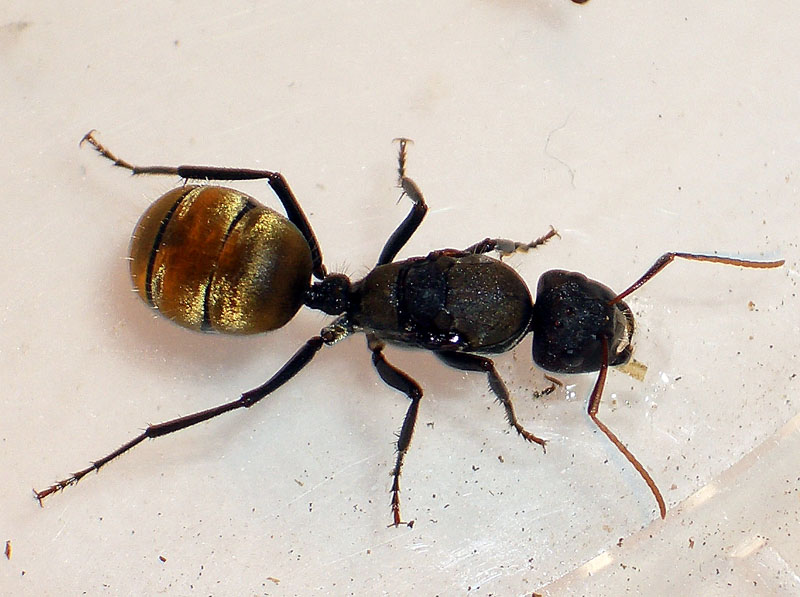


Camponotus sericeus
This is a diurnal, conspicuous golden colored Camponotus species. It will be commonly called as Golden ant due to their golden pubescence on the gaster. Likes very sunny places, will forage alone or in small groups, will direct workers in tandem movement to food source or new nest.
- Taxonomy: Subfamily Formicinae, Tribe Camponotini
- Distribution: South Asia
- Color: black with golden abdomen
- Characteristics: haired abdomen, monogyne
- Size: Queen about 11 - 13 mm
- Nutrition: Honey- or sugar water and insects
- Hibernation: No (see climate)
- Climate: Tropical
- Nest building: Soil nests
- Planting: nothing specific
- Level: easy
Camponotus sericeus was added to the shopping cart. Camponotus sericeus could not be added to the shopping cart.| Small colony
- Currently not available With 10 - 20 workers |


Camponotus habereri
Unique colored Camponotus species from East Asia.Even first workers do have the unique colored stripes of the Queen.
- Taxonomy: Subfamily Formicinae, Tribe Camponotini
- Distribution: East Asia
- Color: red with black-yellow striped abdomen
- Size: Workers: 0.8 - 1.3 cm, Queen: 1.6 cm
- Nutrition: Honey- or sugar water and insects
- Hibernation: No
- Climate: subtropical (moist), Flatland
- Nest building: Wood nests
- Planting: nothing specific
- Level: easy
Camponotus habereri was added to the shopping cart. Camponotus habereri could not be added to the shopping cart.| Colony
- Currently not available With 20-30 workers | |
| Large colony
- Currently not available With approx. 500-1000 workers |


Camponotus gigas
The largest ant of the world.
- Distribution: South-East Asia
- Nest building: wood nests (death wood)
Caution:
This ant is very sensitive, for this reason, no shipping will be offered. The colony offered here has been taken from a queen.
Camponotus gigas was added to the shopping cart. Camponotus gigas could not be added to the shopping cart.| Colony
- Currently not available Queen with 100 workers Shipping restrictions: No shipping is possible, self collecting is required |


Camponotus festinus
- Taxonomy: Subfamily Formicinae, Tribe Camponotini
- Characteristics: polymorph
- Color: light til darkbrown
- Size: up to 12mm
- Distribution: South-East Asia (Malaysia)
- Nutrition: Honey- or sugar water, crickets, flies
- Hibernation: No
- Temperature: 24 - 28 °C (tropical)
- Humidity: Rain forest
- Nest building: moist dead wood especially bamboo
Note: Shipping outside Germany in winter (November-March) only on own risk.
Camponotus festinus was added to the shopping cart. Camponotus festinus could not be added to the shopping cart.| Colony
- 219.00 € With about 200 workers Shipping restrictions: Shipping only within Germany |

Camponotus cf. singularis
- Distribution: Southeast Asia
- Taxonomy: Subfamily Formicinae, Tribe Camponotini
- Hibernation: No
- Color: black with red-brown head
Camponotus cf. singularis was added to the shopping cart. Camponotus cf. singularis could not be added to the shopping cart.| Colony - Currently not available |

Camponotus cf. nicobarensis
A multicolored Camponotus species from South-East Asia.
- Taxonomy: Subfamily Formicinae, Tribe Camponotini
- Distribution: South-East Asia
- Color: multicolored (brown, red, yellow)
- Size: 6 - 12 mm
- Characteristics: polymorph
- Nutrition: Honey- or sugar water and insects
- Hibernation: No
- Climate: tropical (lowland)
- Nest building: Soilnests
- Planting: nothing specific
- Level: easy
Camponotus cf. nicobarensis was added to the shopping cart. Camponotus cf. nicobarensis could not be added to the shopping cart.| Colony
- Currently not available With 5-10 workers | |
| Colony
- Currently not available - with 80-100 workers |


Camponotus cf. irritans
- Taxonomy: Subfamily Formicinae, Tribe Camponotini
- Characteristics: polymorph, nocturnal
- Color: red brown, amber (contrasting color)
- Size: 7 up to 12mm
- Distribution: South-East Asia
- Nutrition: Honey- or sugar water, crickets, flies
- Hibernation: No
- Temperature: 24 - 28 °C (tropical)
- Humidity: Rain forest
- Nest building: dead wood only
This beautiful colored species is really easy to keep.
Camponotus cf. irritans was added to the shopping cart. Camponotus cf. irritans could not be added to the shopping cart.| Small Colony
- Currently not available With 10-20 workers |


Aphaenogaster sp.
- Taxonomy: Myrmicinae
- Color: brown
- Distribution: Southeast Asia
- Nutrition: Honey- or sugar water and insects
- Hibernation: Yes
- Temperature: 26-30°C
- Humidity: moist (tropical)
- Nest building: Soil nests
Aphaenogaster sp. was added to the shopping cart. Aphaenogaster sp. could not be added to the shopping cart.| Colony
- Currently not available With 20-30 workers |
Anoplolepis gracilipes
- Verbreitung: Südasien
- Größe: Königin : 12-14mm, Arbeiterinnen ca. 4-5mm
- Farbe: gelblich
- Winterruhe: Nein
- Nestbau: Erdnester, sehr oft in hohlen Kokosnüssen, keine besonderen Ansprüche
- Nahrung: Insekten und Honig-/Zuckerwasser
- Bodenbeschaffenheit: Sand, Lehm, Humus
- Bepflanzung: beliebige tropische Pflanzen
- Besonderheit: Verteidigt sich schnell mit Ameisensäure, schnell laufend, gut zu haltende Ameise, trockene Haltung wird empfohlern es muss aber Zugang zu Wasser möglich sein. Zieht bei Störungen sehr schnell um. Auch die Königinnen sind sehr mobil.
Anoplolepis gracilipes was added to the shopping cart. Anoplolepis gracilipes could not be added to the shopping cart.| Empty
- Currently not available Mit mindestens zwei Königinnen und über 1000 Arbeiterinnen, schöne etablierte Kolonie- NUR zur Abholung - Shipping restrictions: No shipping is possible, self collecting is required |
RENDERING: 72 ms, LOADING: ? ms
Article number: teru0001